Saying beats reading
Words said out loud are remembered better than words read in silence. It is called the production effect.
MacLeod and others, 2010. Forrin and MacLeod, 2018.
Other preparation gives you answers to read. This one makes you say them, because saying is what the interview asks for.
The short answer, and the background behind it.
Out loud, against a 15 second clock, answer hidden.
Tick what you said. What you missed comes back.
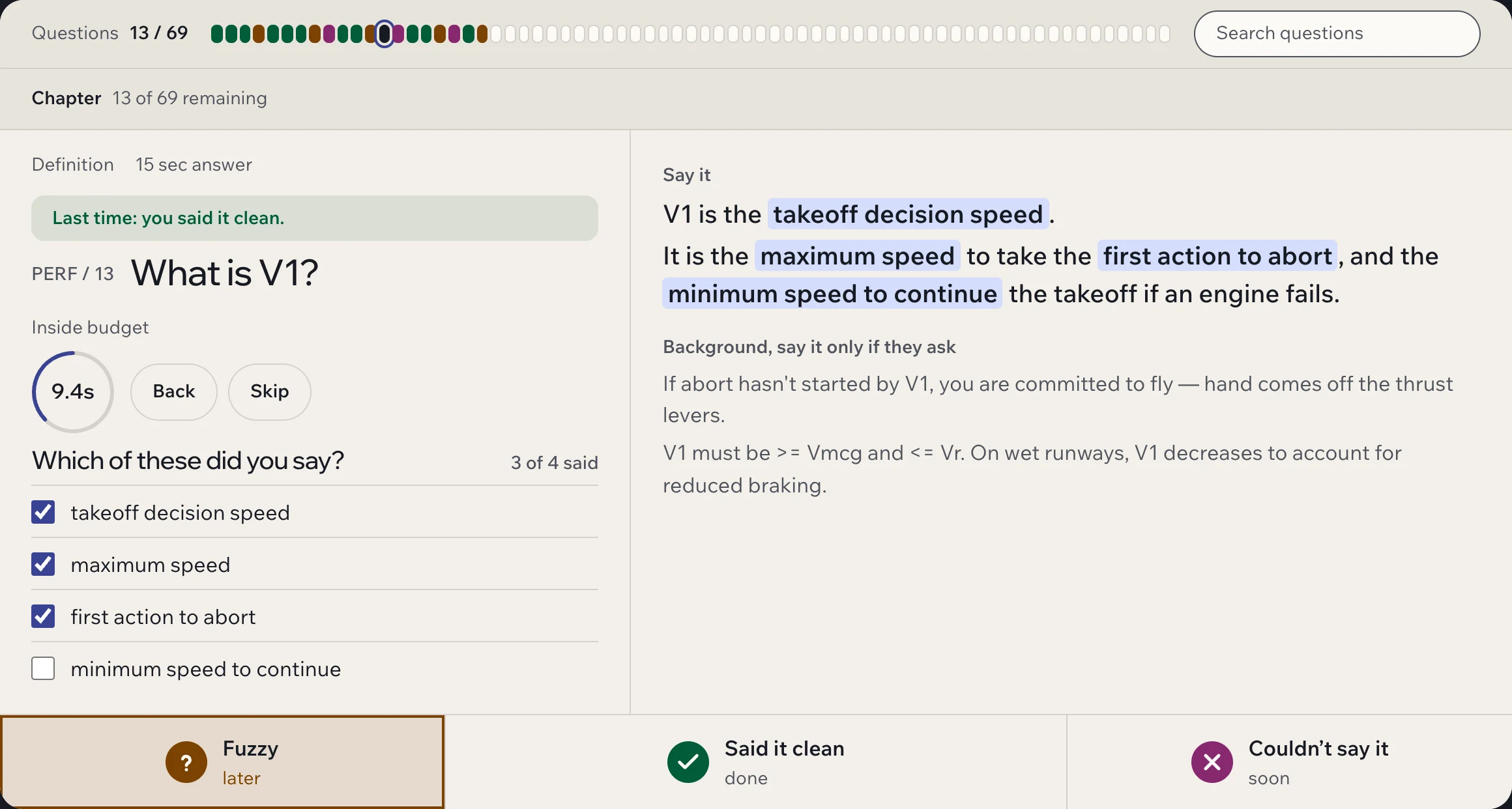
A preview of the real drill, playing by itself. Press a step to see it again.
A walkthrough of one real card from the Performance chapter, What is V1? You read the question while the answer is hidden. You press Start and say your answer out loud against a 15 second clock. You press again and tick the key phrases you said, three of the four. Then you see the model answer, the part to say and the background. The ticks suggest Fuzzy, and you press Fuzzy. The tally moves, the next card, What is Vr?, comes in, and later What is V1? comes back with the note: Last time: fuzzy. Say it clean and it will not come back.
Talking to an empty room feels strange. It is also the part that works.
Four findings from published research on learning. They are why the drill is built this way.
Words said out loud are remembered better than words read in silence. It is called the production effect.
MacLeod and others, 2010. Forrin and MacLeod, 2018.Students who tried to recall a text remembered more a week later than students who read it again.
Roediger and Karpicke, 2006.Self-testing was rated among the most useful of ten study techniques. Re-reading and highlighting were among the least.
Dunlosky and others, 2013.Across many studies, learning with game elements, such as scores, progress and challenges, gave better results and more motivation. The drill uses them: a clock to beat, a deck you clear card by card, a score for every chapter.
Sailer and Homner, 2020.These studies were done with students, not with pilots in interviews. They explain how the drill is built. They are not a promise about your result.
MacLeod, Gopie, Hourihan, Neary and Ozubko (2010), Journal of Experimental Psychology: Learning, Memory, and Cognition, 36(3), 671 to 685. Forrin and MacLeod (2018), Memory, 26(4), 574 to 579. Roediger and Karpicke (2006), Psychological Science, 17(3), 249 to 255. Dunlosky, Rawson, Marsh, Nathan and Willingham (2013), Psychological Science in the Public Interest, 14(1), 4 to 58. Sailer and Homner (2020), Educational Psychology Review, 32(1), 77 to 112.
Three other ways people prepare. All are real products. We keep their names blurred.
| Who | What you get | Where it stops | Price |
|---|---|---|---|
| Real competitor 1A real product. Its name is hidden.A large question collection | 10,000+ questions and answers sent in by candidates, for about 30 airlines. | The answers are as candidates remember them. It is a list to read. | About €50 to €80, once |
| Real competitor 2A real product. Its name is hidden.An AI mock interviewer | Software asks about 900 questions and replies to what you say. | Software judges your answer, not a pilot. | $195 to $295, once |
| Real competitor 3A real product. Its name is hidden.One-to-one coaching | A coach interviews you live, online. | One session. To repeat, you pay again. | From about €380 a session |
| This is usPilot Interview PrepA timed spoken drill | Over 600 drill cards, each with one short answer checked by an A320 First Officer. You say every one out loud against a clock, as often as you want. | Nobody listens to you. You rate yourself, with the key phrases as a check. | €69, once, for 12 months |
Figures and prices were checked in October 2026. They change, so check each product before you buy.